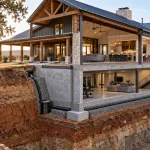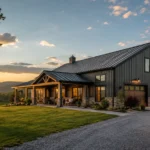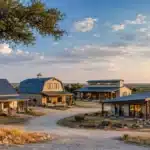
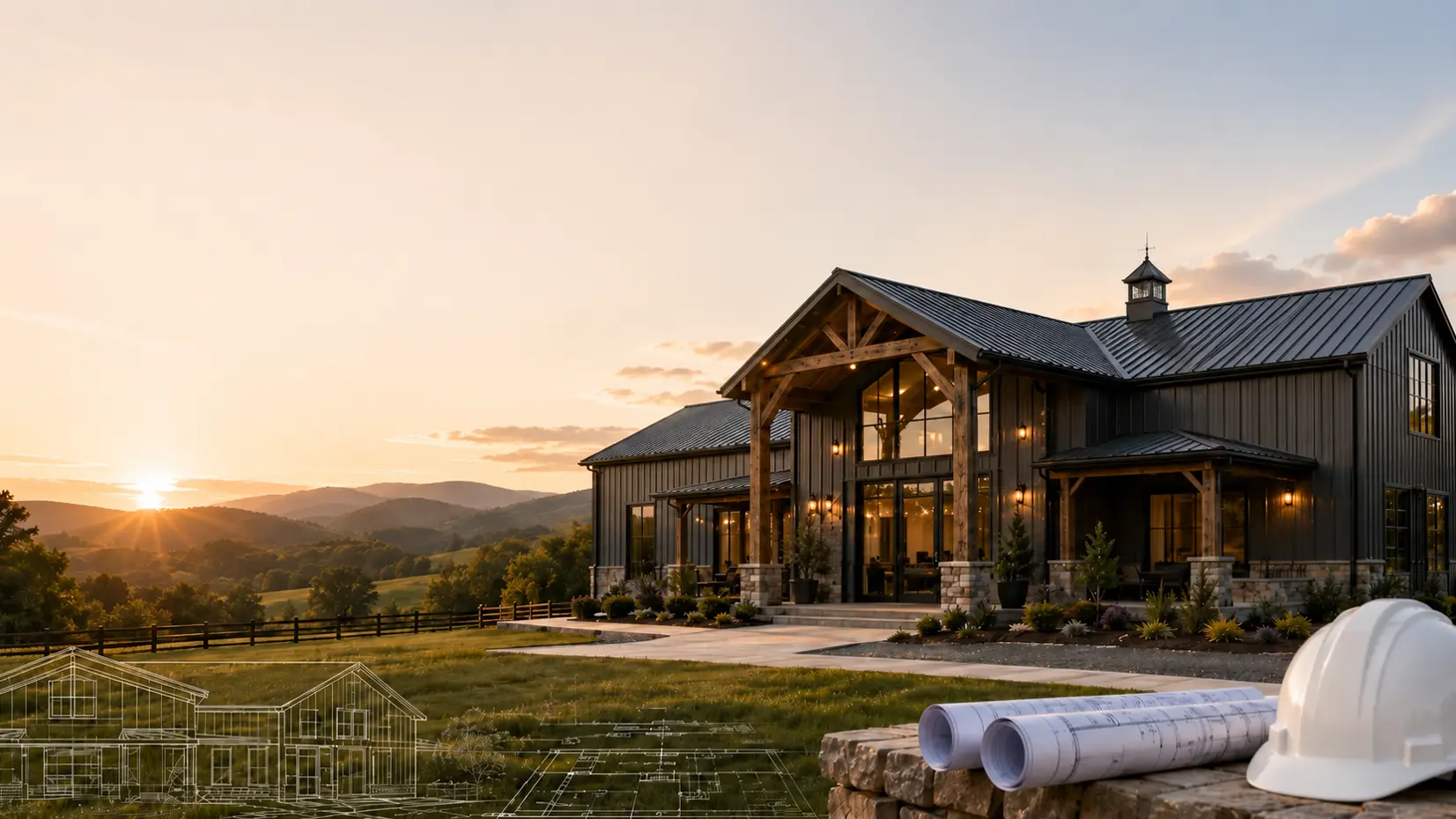
How much land you need for a barndominium in Texas has less to do with the building than with everything that has to fit around it. A 2,400 square foot barndo covers about a twentieth of an acre. The septic drain field, the water well, the setbacks between them, the driveway and the space to turn a concrete truck around take up far more than the house does.
Most Texas barndominium sites work well between 1 and 5 acres. State septic rules set a hard floor below that. This guide explains where those numbers come from and what changes county to county.
The Short Answer on How Much Land You Need for a Barndominium in Texas
There is no statewide minimum acreage for a home in Texas. What exists instead is a stack of separate rules, and the strictest one that applies to your property becomes your real minimum. In practice, the ranges break down like this:
- Under 0.5 acre: Workable only where public water and public sewer are both available, which usually means inside city limits
- 0.5 to 1 acre: Possible with public water plus an on-site septic system, though the layout gets tight
- 1 to 2 acres: The realistic minimum when you need both a private well and a septic system
- 2 to 5 acres: The most common range for rural Texas builds, leaving room for a shop, drainage and outbuildings
- 10 acres and above: Opens up a septic permitting exemption and makes agricultural valuation worth considering
The gap between those numbers matters. Buyers regularly close on a parcel at the bottom of the range, then discover the site plan will not fit once the septic designer marks the required separation distances.
What Actually Sets the Minimum Acreage in Texas
Texas has no statewide zoning code. Counties have limited authority to zone rural land, which is exactly why barndominiums are so common here. That freedom is real, but it does not mean the land is unregulated.
Four separate systems decide how small your parcel can be:
- Wastewater rules enforced under the Texas Commission on Environmental Quality (TCEQ) through your county
- Water supply, meaning either a utility connection or a drilled well with its own spacing requirements
- Subdivision and plat restrictions, including deed restrictions and any property owners association
- City extraterritorial jurisdiction (ETJ), which can pull rural-looking land within five miles of a city into that city’s platting and permitting rules
The ETJ point catches people out. Land can sit well outside a city and still fall under its subdivision requirements. Getting land selection support before you sign anything costs far less than discovering a jurisdictional problem after closing.
Septic Rules Set the Real Floor in Texas
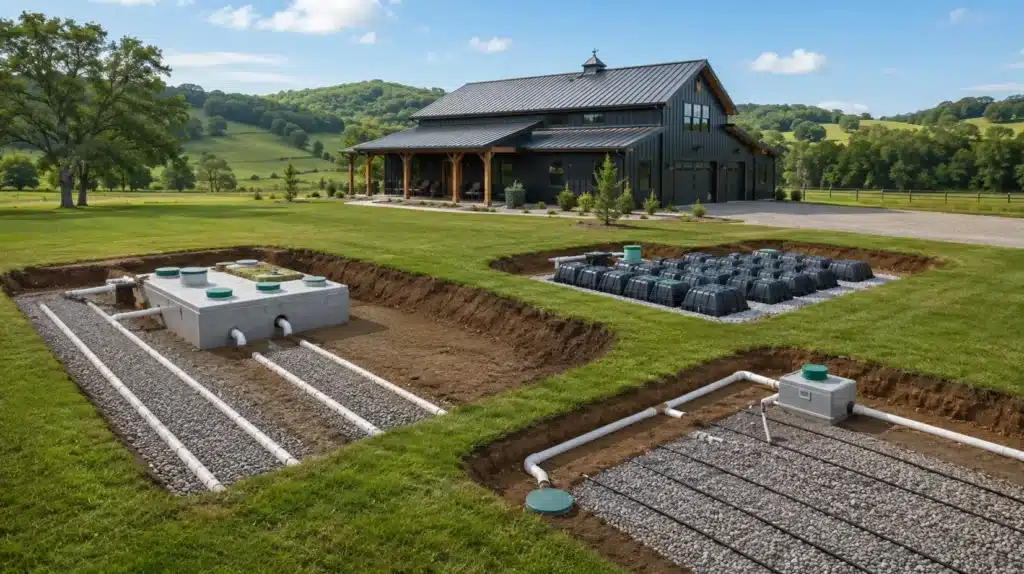
For most rural barndominium projects, wastewater is the binding constraint. Texas regulates on-site sewage facilities (OSSFs) under 30 TAC Chapter 285, and those rules are enforced locally by county authorized agents rather than by TCEQ directly.
The lot size requirement depends on your water source. Subdivisions of single-family dwellings not served by a public water supply and using individual OSSFs must have lots of at least one acre. Where public water is available, the threshold drops to half an acre in most counties.
Three exceptions are worth knowing:
- Pre-1988 lots: Tracts subdivided before 1 January 1988 can often use a septic system regardless of size, provided every setback is still met
- The 10-acre rule: Single-family homes on 10 acres or more are exempt from OSSF permitting, as long as no effluent crosses a property line
- Edwards Aquifer recharge zone: Every lot with an OSSF on the recharge zone needs at least one full acre per dwelling, with stricter design review on top
The 10-acre exemption is widely misunderstood. It removes the permit requirement, not the design standards. The system still has to be built to code, and a future sale can trigger retroactive permitting. Experienced barndo builders in Texas will usually recommend permitting the system anyway to keep the file clean for resale and appraisal.
Wells, Setbacks and Your Buildable Envelope
Acreage on a deed is not the same as buildable area. Once the required separation distances are drawn on a site plan, a surprising amount of a small parcel becomes unusable.
The state minimums published by the Texas Department of Licensing and Regulation that shape a barndominium site include:
- 50 feet between a water well and a septic tank
- 100 feet between a water well and a drain field or spray area
- 50 feet between a well and the property line, reducible to 5 feet only with pressure-cemented casing to depth
- 5 feet from septic components to property lines and building foundations, with far larger distances for spray systems
- 75 feet or more from surface water, depending on its use
Counties can require more distance than the state minimum, never less. On a half-acre lot with a well, those circles overlap almost immediately, which is why aerobic treatment units are so common on tight Texas sites. They discharge cleaner effluent and need less disposal area, but they carry a mandatory maintenance contract and scheduled inspections. Working with a turnkey barndominium builder in Texas means the septic design, the well location and the foundation are laid out together rather than sequentially.
Want to speak to a barndominium builder in Texas?
How Much Land the Barndominium Itself Takes Up
The structure is the smallest part of the equation. A 40×60 building covers 2,400 square feet, or roughly 0.055 acres. A generous 60×80 covers 4,800 square feet, still only about 0.11 acres.
What consumes space is everything else the build requires:
- Driveway and culvert, plus a turnaround area for delivery and concrete trucks
- Working room around the slab for equipment during construction, typically 20 to 30 feet on all sides
- Septic tank and disposal field, plus a reserve area many counties require
- Well head and pressure tank with clear access for future service
- Propane tank, utility easements and overhead line clearances
- Graded drainage away from the slab, which matters enormously on flat or clay ground
Sizing the land before sizing the building is the wrong order. Comparing barndominium floor plans for Texas early gives you a real footprint and shop ratio to measure a parcel against, instead of guessing at acreage and adjusting the design later.
Learn if barndominiums can have a basement in Texas.
Land Requirements by Region Across Texas
Texas is not one building environment. The same 2 acres behaves very differently depending on where in the state it sits, and regional ground conditions often push the practical minimum higher than the legal one.
Hill Country and the Edwards Aquifer
Thin soil over limestone is the defining feature here. Rock excavation raises costs for foundations, trenching and septic installation, and shallow soil can disqualify a conventional drain field outright.
Properties on the Edwards Aquifer recharge zone face the one-acre-per-dwelling minimum plus enhanced setbacks from recharge features. That zone runs through Bexar, Comal, Hays, Travis, Williamson, Uvalde, Medina and Kinney counties. San Antonio barndo builders deal with these requirements constantly, and the aquifer protection review adds time that needs to be built into the schedule.
Blackland Prairie and North Texas
The clay belt running through Dallas, Ellis, Collin and Hunt counties has high shrink-swell potential. Soil expands when wet and contracts in drought, which is hard on slabs and hard on drain fields.
Two things follow from that. Foundations need engineering specific to the soil report rather than a standard slab detail, and clay drains poorly enough that aerobic systems are often the only workable option. Homeowners planning a build with barndominium builders in Dallas Texas should budget for a geotechnical report before finalising the footprint, because the soil result can change where on the parcel the building goes.
East Texas
Higher rainfall, sandy loam soils and a shallower water table define the Piney Woods. Drainage planning matters more here than almost anywhere else in the state, and a high seasonal water table can restrict which septic systems are permitted.
Tree clearing is a real line item too. A heavily wooded 3-acre tract may only yield a modest clearing once you account for the drain field and the driveway. East Texas barndominium builders price clearing, stump removal and haul-off separately, and those costs scale with how much of the parcel you actually need to open up.
West Texas
Land is cheaper and parcels are larger, but the constraints shift. Caliche layers complicate excavation, groundwater can be deep or unreliable, and wind loads are a genuine engineering input for a metal building rather than a formality.
Water access often decides the acreage question out here. If a well has to go several hundred feet down, or the aquifer will not support a household draw, buyers end up needing rainwater catchment or hauled water. West Texas barndominiums are frequently designed around the water solution first and the floor plan second.

Ag Valuation, Rollback Taxes and Acreage in Texas
Agricultural valuation is one of the main reasons Texas buyers look at 10 acres or more. Under 1-d-1 open-space valuation in the Texas Property Tax Code, land is taxed on productivity value rather than market value, which can cut the tax bill dramatically.
The qualifying rules are set locally, not statewide:
- Land must be devoted principally to agricultural use to the degree of intensity generally accepted in the area
- It must have been in qualifying use for five of the preceding seven years
- Each county appraisal district publishes its own intensity standards, so stocking rates and minimum acreage vary
- Grazing typically needs 10 or more acres, while beekeeping can qualify tracts in the 5 to 20 acre range
- The valuation applies to land only, never to the barndominium itself
Building triggers a change of use on the homesite portion, which brings rollback taxes on that carved-out area. Since House Bill 1743 took effect in September 2019, the rollback on open-space and timber land covers the previous three years plus 5 percent annual interest, down from five years and 7 percent. Many articles still quote the old figures. Because the carve-out is proportional, building on 2 acres of a 40-acre tract only rolls back those 2 acres, provided the remainder stays in qualifying use and the appraisal district paperwork reflects the split. Lining up barndo financing support for Texas at the same time helps, since lenders treat ag-valued land and construction draws differently from a standard residential purchase.
Common Land Mistakes Texas Barndominium Buyers Make
The same handful of problems come up again and again, and nearly all of them are discovered after closing rather than before.
- Buying before a site evaluation. Soil suitability for septic is not visible from the road, and a failed evaluation can make a parcel unbuildable as planned
- Assuming legal access. An easement across a neighbour’s land needs to be recorded and wide enough for construction equipment, not just a pickup
- Ignoring the floodplain. FEMA mapping affects insurance, finished floor elevation and sometimes permitting
- Overlooking deed restrictions. Unzoned does not mean unrestricted, and some restrictions specifically exclude metal exteriors or set minimum square footage
- Forgetting utility distance. Running electricity several hundred feet from the nearest pole can cost more than the septic system
- Not checking mineral rights. Severed mineral interests can allow surface access for drilling on your parcel
Utility distance deserves particular attention. Land priced attractively per acre is often priced that way because service is far from the road, and that gap gets paid for at build time. Understanding how much a barndominium costs to build in Texas is only meaningful once site work, utility runs and access are priced into the same number.
The most reliable protection is having someone walk the property before the option period expires. A custom barndominium builder in Texas can flag slope, access, drainage patterns and likely foundation requirements in a single visit, well before earnest money is at risk.
Learn more about how to finance a barndominium in Texas.
Conclusion: Sizing Land for Your Texas Barndominium
The honest answer is that acreage is an output, not an input. Work backwards from your water source, your wastewater system, your building footprint and your county’s rules, and the minimum parcel size becomes obvious. For most Texas buyers that lands between 1 and 5 acres, with 10 acres unlocking permitting and tax advantages worth weighing separately. Whatever the number, verify the site evaluation, the access and the utility distances before closing. Land problems are cheap to avoid at the option stage and expensive to solve once the slab is poured.
Frequently Asked Questions
Can you build a barndominium on 1 acre in Texas?
Yes, and 1 acre is a common size for rural Texas barndominium builds. It satisfies the one-acre septic minimum that applies where there is no public water supply, and it leaves enough room for a well, a drain field and a driveway. The layout gets tight if you also want a large shop or outbuildings.
Do you need 10 acres for a barndominium in Texas?
No. Ten acres is not a requirement, it is a threshold. At 10 acres or more, a single-family home is exempt from OSSF permitting provided no effluent crosses a property line, and agricultural valuation becomes realistic in most counties. Plenty of Texas barndominiums are built on 1 to 5 acres.
Do Texas counties require permits to build a barndominium?
It varies significantly. Most rural Texas counties do not issue building permits for residential construction, but nearly all require a septic permit through the county authorized agent. If the land falls inside a city or its extraterritorial jurisdiction, full permitting and inspections usually apply.
Does building a barndominium cancel an ag exemption in Texas?
Only for the portion converted to residential use. The homesite acreage around the barndominium loses its agricultural valuation and triggers rollback taxes on that area, currently three years plus 5 percent interest. The remaining land keeps its valuation as long as qualifying use continues and the appraisal district is notified.
How much of a parcel is actually buildable for a barndominium?
Less than most buyers expect. After septic setbacks, well separation distances, easements, drainage and construction access, a 1-acre parcel may offer well under half its area as genuinely usable building envelope. A site evaluation and a scaled site plan are the only reliable way to know before you buy.