Financing is the step that stops most barndominium projects in Texas, not the build itself. After 25 years of construction work across the state, the pattern is consistent: the money is available, but the process looks nothing like buying a finished house in a subdivision. You are usually financing land, construction and a permanent mortgage, sometimes in one closing, for a property type some underwriters still have no category for. This guide covers which loans work here, what lenders ask for, how land fits in, and where approvals stall.
Can You Finance a Barndominium in Texas? The Short Answer
Yes. Barndominiums were once cash-and-savings projects, but that changed as the building type spread across rural Texas. Banks, credit unions and Farm Credit associations now write loans on them every month.
What has not changed is how a lender thinks. A bank is not judging whether a steel-framed home is a good idea. It is asking three questions:
- Can this property be classified as a residential dwelling under the loan program’s guidelines?
- Can an appraiser support the finished value with comparable sales?
- Is the builder capable of finishing the project at the price quoted?
Answer those three cleanly and the file moves. Leave one vague and it sits. A turnkey barndominium builder in Texas hands the bank a single contract covering design, engineering and construction, which removes the coordination risk that makes underwriters nervous about non-traditional builds.
Why Lenders Treat Barndominiums Differently
The hesitation is rarely about the structure. Steel and post-frame buildings are engineered to the same wind load requirements as any other home in the county. The friction sits elsewhere, and four issues come up repeatedly:
- Appraisal comparables. Appraisers value a property against recent sales of similar homes, and in rural counties the nearest sold barndominium may be 20 miles away.
- Property classification. If too much square footage reads as shop, storage or agricultural space, some lenders will not treat it as a residence.
- Secondary market rules. Loans sold to Fannie Mae or Freddie Mac must fit program guidelines, so anything unusual gets scrutinized harder.
- Builder risk. Construction lending exposes the bank for 6 to 12 months on a partially built asset, and an unproven builder worsens that exposure.
Experienced barndo builders in Texas keep the documentation package ready before the application goes in, because underwriting will ask for all of it eventually. Producing it in week one rather than week six is often the difference between a 30-day approval and a 90-day one.
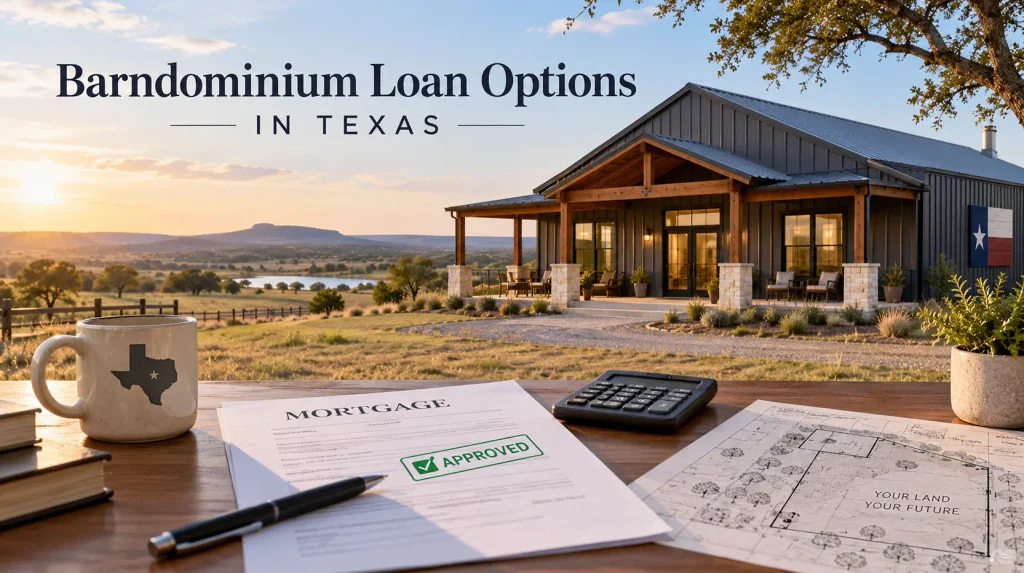
Barndominium Loan Options in Texas
There is no single “barndominium loan.” There are standard products that either allow the property type or do not. These are the paths that work most often here.
Construction-to-Permanent (One-Time Close)
This is the most common structure for a new build. You close once, before construction starts, and the loan converts to a long-term mortgage at completion. The land purchase can usually be rolled into the same note.
- One closing instead of three, which saves on fees and title costs
- Typically 10% to 25% down, depending on lender and credit profile
- Interest-only payments during construction, based on funds drawn to date
- Requires a licensed builder, fixed budget and full plan set up front
Two-Close Construction Loans
Here you take a short-term construction loan, then refinance into a permanent mortgage at completion. It suits buyers who expect rates to fall or plan to finish the interior themselves. The trade-off is a second set of closing costs and the risk that rates or your circumstances change first.
Farm Credit and Rural Home Loans
Farm Credit associations are often the most straightforward option for acreage builds. They lend on rural property daily, understand land values outside the metros, and treat barndominiums as dwellings. Many offer construction and homesite loans on terms national banks will not match on rural collateral.
USDA Section 502 Loans
Much of Texas outside the major metros qualifies as rural under USDA maps. The Section 502 Guaranteed program offers zero-down financing subject to household income limits, and some lenders offer single-close construction versions. The home must be your primary residence on a permanent foundation and meet USDA property standards.
VA Loans and the Texas Veterans Land Board
Veterans have two separate benefits in Texas. A federal VA loan can finance a barndominium that meets Minimum Property Requirements and appraises. Separately, the Texas Veterans Land Board runs a state land loan program for eligible veterans and military members buying tracts of one acre or more, with a low down payment and a capped loan amount.
Portfolio Loans from Local Banks and Credit Unions
A portfolio lender keeps the loan on its own books, so it writes its own underwriting rules. Community banks in rural counties have often financed dozens of similar builds and know which local appraisers can value them. Buyers frequently ask us for barndo financing support before choosing a lender, which is the right order.
What Usually Does Not Work
- Personal loans and kit financing, which cover the shell and leave the slab, interior and site work unfunded
- Standard mortgages on a property still classified as an agricultural or accessory building
- Owner-builder construction loans, which most Texas banks decline regardless of experience
Need financing guidance for a barndominium in Texas?
Financing the Land: What Texas Buyers Need to Know First
Land is where most Texas barndominium budgets get away from people. A land loan is not a mortgage. Lenders treat dirt as riskier collateral because it produces no shelter and can be slow to sell, so terms are shorter and down payments higher. Texas lenders sort tracts into three categories:
- Improved lots with utilities, road frontage and a clear building path. Lowest risk, often 10% to 20% down.
- Unimproved land with partial access or some infrastructure. Commonly 15% to 25% down.
- Raw land with no utilities, no road access and no entitlements. Hardest to finance, with down payments that can reach 35% or more.
Before setting a land budget, work out how much a barndominium costs to build in Texas at your finish level. Buyers routinely spend the whole budget on acreage, then find the build no longer fits, which forces a redesign and restarts the lending conversation.
Site costs sit outside the building price and lenders want them itemized. Well drilling, septic design, electrical service runs, culverts and pad work can add tens of thousands of dollars depending on the county. On rural tracts, verify road access, flood zone status, water and septic feasibility before you sign.
One Texas-specific point: an agricultural exemption lowers property taxes substantially, but it is a valuation method tied to qualifying use, not a permanent status. Building on part of the tract usually removes that portion from ag valuation, and appraisal districts set their own acreage rules. Ask the district directly, not the seller.
Lender Requirements for a Texas Barndominium Build
The borrower side of underwriting is conventional. Most Texas lenders look for:
- A credit score of 620 minimum, with 680 or higher opening better terms
- Debt-to-income ratio under 43% in most programs
- Documented, stable income via pay stubs, tax returns or business records
- Cash reserves beyond the down payment, often several months’ worth
- Down payment of 10% to 25%, varying by loan type and lender
The project side is where barndominium files differ. Underwriters will not order an appraisal until they have final barndominium floor plans, a specification sheet and a line-item budget with no open allowances. Vague finish schedules and missing site-work numbers are the most common cause of delay we see.
Lenders also vet the builder. Expect requests for proof of general liability and builder’s risk insurance, references, and a signed fixed-price contract with a defined completion timeline. Some banks keep an approved builder list and will not lend outside it.
The appraisal is done “subject to completion,” meaning the appraiser values the home as if it already exists, working from your plans and specs. The best comps are finished barndominiums sold in the last 12 months, then custom homes on similar acreage and finish level. Raw land and manufactured housing sales will not support the value.
How the Construction Draw Schedule Works
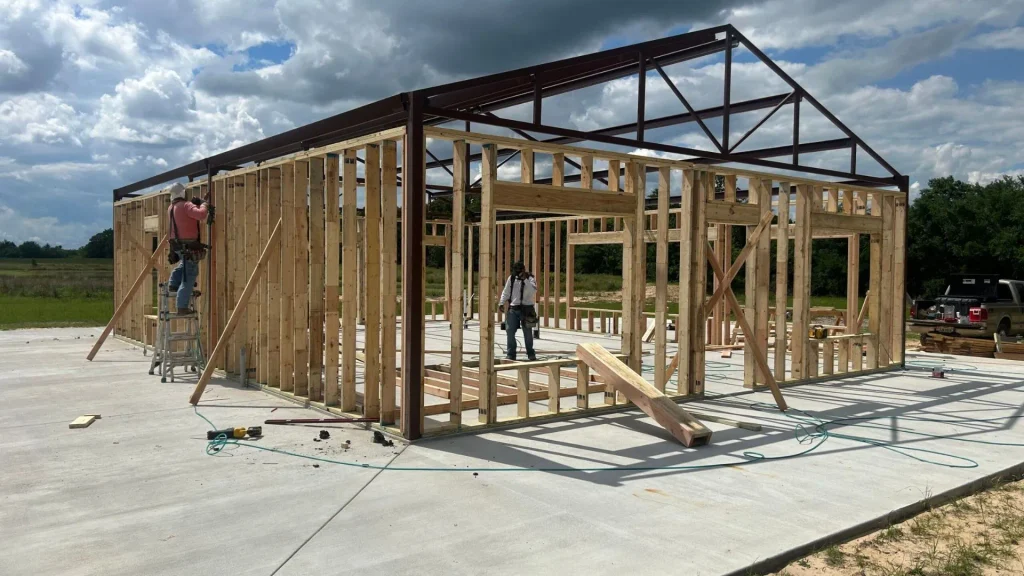
Construction money is not handed over in a lump sum. The lender releases it in draws as the build hits agreed milestones, usually with an inspection before each release. A typical Texas schedule runs across slab, framing and shell, dry-in, mechanical rough-in, interior finish and final completion. A few points catch first-time builders out:
- You pay interest only on the funds drawn to date, so payments climb as the build progresses
- Most construction loans carry a 12-month term, and extensions cost money
- Lenders often hold back a retainage percentage until final inspection
- A 5% to 10% contingency line is worth budgeting even when the lender does not require it
The Texas Real Estate Research Center at Texas A&M makes the same point we make to clients: ask about the draw inspection process before you sign, and make sure each draw is backed by itemized invoices. Their guidance on financing and building a barndominium covers the borrower’s side.
How Barndominium Financing Varies Across Texas Regions
Texas is not one lending market. Appraisal comps, land pricing, county permitting and the lender mix all shift depending on where you build.
North Texas counties around the Metroplex have some of the deepest pools of recent barndominium sales in the state, which makes appraisals easier than most people expect. Land is the constraint here rather than financing.
Barndominium builders in Dallas work under city and suburban permitting rules that rural counties do not apply, including deed restrictions and HOA covenants that can prohibit metal exteriors outright. Metro lenders are comfortable with the product, but a covenant discovered after closing on land is an expensive mistake.
San Antonio barndo builders deal with a split market: platted lots inside Bexar County on one side, Hill Country acreage with rock excavation and well depth issues on the other. Those scenarios produce very different site-cost lines, and lenders price the risk accordingly.
Land prices across Central Texas have risen faster than build costs, which pushes more buyers toward one-time-close loans that fold the land into the construction note rather than tying up cash in a separate land loan.
East Texas barndominium builders tend to have the smoothest lender conversations in the state, because Farm Credit associations and long-established community banks there have financed rural construction for decades and understand the property type already.
West Texas barndominiums often sit on large tracts where the nearest comparable sale is 30 miles away, so appraisals take longer. Local and regional lenders are the better route here, since an out-of-state underwriter has no context for the market.
In South Texas, water availability and well depth carry more weight in the site budget than elsewhere, and coastal counties add windstorm insurance and stricter engineering requirements that must be priced in before the loan is sized.
Common Mistakes That Delay or Kill Approvals
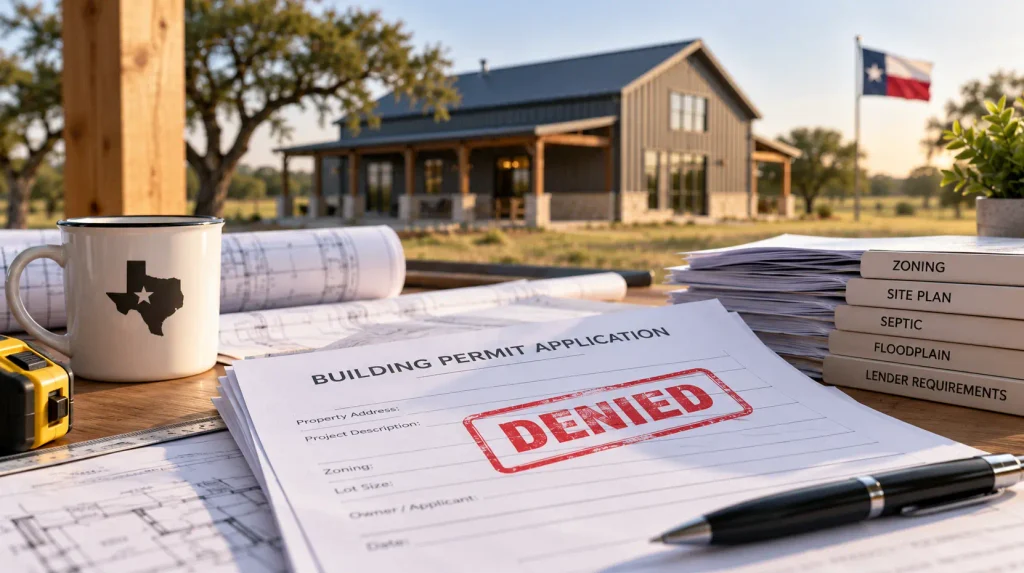
Most declined barndominium files fail for avoidable reasons rather than credit. The ones we see most often:
- Buying land before checking deed restrictions, flood zone status or septic feasibility
- Submitting a budget with open allowances instead of firm line-item costs
- Designing a shop-heavy layout that pushes the residential portion below program limits
- Applying to one national bank, getting declined, and assuming that is the end of it
- Leaving site work, utility runs and driveways out of the budget
- Choosing a builder with no construction lending track record
The shop percentage issue deserves attention. If the finished building reads more like a workshop with living quarters than a home with a shop attached, some programs will not classify it as a residence. That decision is made on paper months before the loan application, and it is far cheaper to solve there than in underwriting.
Practical Steps to Improve Your Chances of Approval
Getting approved is largely about sequencing. The right order removes most of the friction before a lender sees the file.
- Talk to two or three local lenders early, including a Farm Credit association
- Confirm the land’s building path first: access, utilities, flood zone, restrictions
- Finalize plans and specifications before applying, not during underwriting
- Ask your builder for comparable finished projects the appraiser can reference
- Avoid new debt from application through to final draw
- Budget a contingency and keep reserves after the down payment
The builder’s role here is larger than most buyers expect. When design, engineering and construction sit with one company, the lender gets a single fixed-price contract, one point of accountability and a documentation package that matches what underwriting needs. Split that across a designer, a shell supplier and three subcontractors, and the bank sees a coordination problem it has to price for.
Conclusion
Financing a barndominium in Texas is achievable, but it rewards preparation in a way that buying an existing house does not. The property type is no longer unusual here, and lenders across the state write these loans regularly. What decides the outcome is whether your file answers the lender’s questions before they ask: a defensible appraised value, a clear residential classification, complete plans with a fixed budget, and a builder the bank can verify. Get land, design and lender conversations running in the right order and financing stops being the hard part.
Frequently Asked Questions
Do Texas banks actually finance barndominiums?
Many do, though not all. Community banks, credit unions and Farm Credit associations in rural Texas finance them regularly, while some national lenders still decline them as non-standard construction. A no from your first lender usually reflects that institution’s guidelines rather than a problem with your project.
Can you use a VA or USDA loan to build a barndominium in Texas?
Both are possible with conditions. The property must be your primary residence on a permanent foundation and meet the program’s property standards, and the appraisal must be supportable with comparable sales. The bigger practical hurdle is that not every VA or USDA lender offers construction financing, so confirm that first.
How much do you need as a down payment for a barndominium in Texas?
Most construction loans require 10% to 25% down, depending on your credit profile, the lender and the loan type. Land loans sit higher, from around 15% on improved lots to 35% or more on raw acreage. USDA and VA programs can reduce or remove the down payment for borrowers who qualify.
Can land you already own count toward the down payment?
Usually, yes. If you own the tract outright or hold significant equity in it, most lenders apply that equity toward your required contribution on a construction loan. It is one of the main reasons buyers purchase land first, and it can substantially reduce cash needed at closing.
Can you get a 30-year mortgage on a barndominium in Texas?
Yes, provided the finished home is classified as a residential dwelling and the appraisal supports the value. A construction-to-permanent loan converts automatically at completion, which is the most common route. Where a lender will not classify the property as a residence, terms tend to be shorter and rates higher.