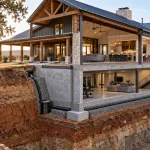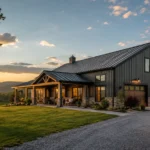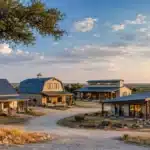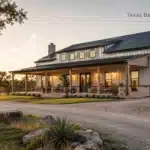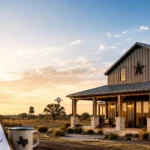
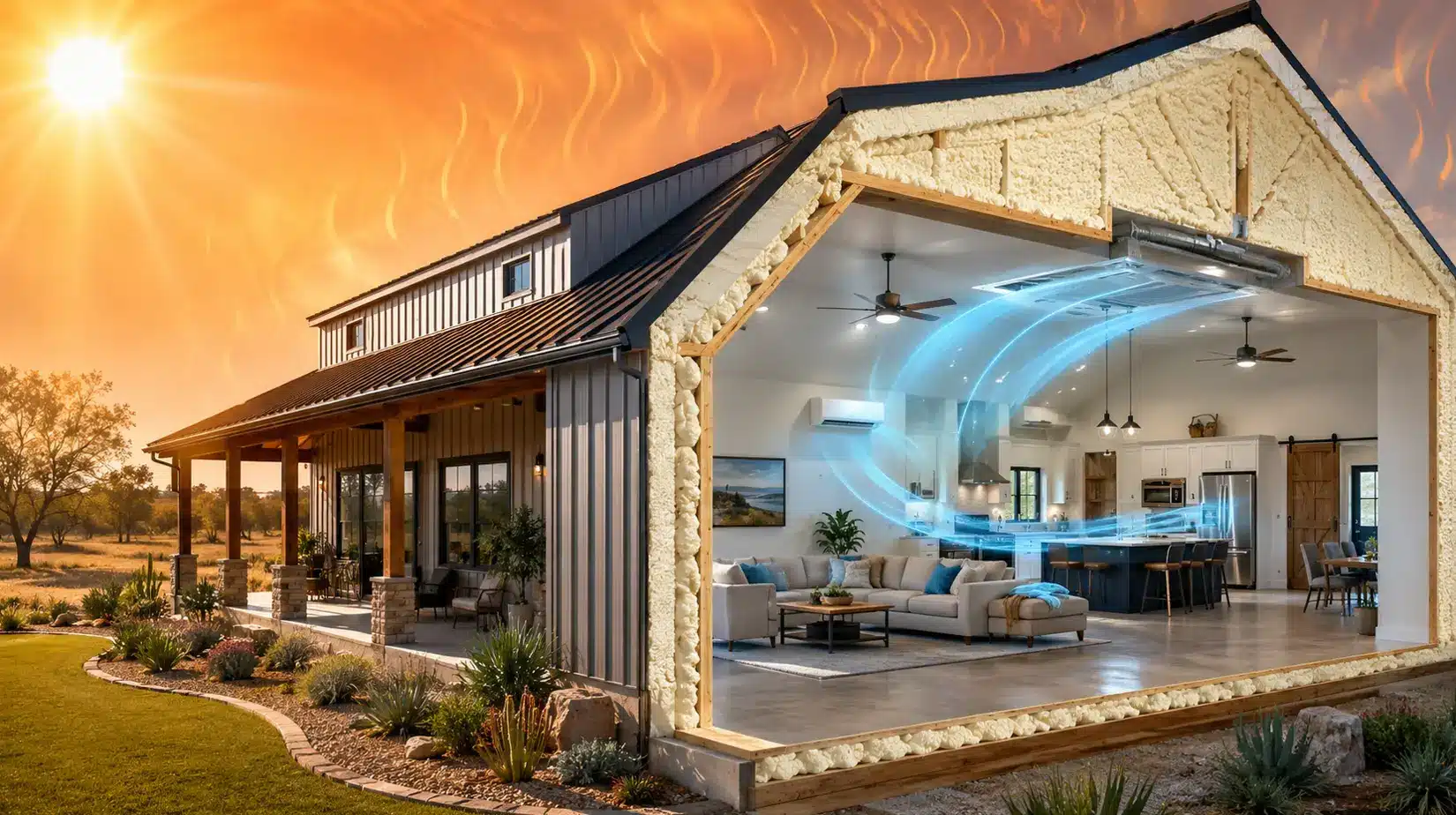
Texas is not a forgiving climate for an under-insulated building. Summer temperatures push past 100°F across much of the state, humidity along the Gulf Coast drives up cooling loads, and a metal exterior, if not properly handled, will absorb and radiate heat straight into your living space. Energy efficiency in a Texas barndominium is a core part of how the building gets designed, insulated, and mechanically conditioned from the ground up.
Why Metal Structures Need a Different Approach to Energy Efficiency
A barndominium built on a steel or metal frame behaves differently than a stick-built home when it comes to temperature control. Metal conducts heat and cold rapidly, a property called thermal conductivity, which means without the right insulation strategy, your interior temperature will track the exterior far too closely.
The two biggest issues in Texas:
- Radiant heat gain: Metal roofing and siding absorb solar radiation and re-radiate it inward. On a 100°F summer day in West Texas or Central Texas, an uninsulated metal roof can reach surface temperatures well above 150°F. That heat has to go somewhere.
- Thermal bridging: Metal framing members (purlins, girts, columns) act as direct conductors between the exterior and interior. Even if you install batt insulation between framing, the metal itself bypasses it entirely.
These are structural physics problems, not cosmetic ones. Addressing them requires specific insulation systems, not just generic “add insulation” thinking. The good news is that when done right, a well-insulated barndominium can outperform a conventional stick-built home on energy efficiency. The large thermal mass of a slab foundation, tight building envelope, and efficient mechanical systems work together effectively.
Understanding what makes Texas different for barndominium builds is the first step. The state’s climate diversity alone means insulation and HVAC strategies that work in Amarillo don’t automatically translate to Houston or Laredo.
Texas Climate Zones and How They Shape Your Insulation Strategy
Texas spans three IECC (International Energy Conservation Code) climate zones:
- Climate Zone 2: South Texas, the Gulf Coast, and the Rio Grande Valley. Hot and humid year-round, with mild winters. Cooling load dominates almost entirely.
- Climate Zone 3: Central Texas, the Hill Country, the Dallas-Fort Worth area, and most of East Texas. Hot summers, moderate humidity, and cold snaps in winter that can drop below freezing.
- Climate Zone 4 (partial): The Texas Panhandle and parts of the far north. True winter heating loads, with cold, dry conditions.
Your climate zone directly determines the minimum R-values required by code and the practical insulation targets you should be hitting. A barndominium built in South Texas has very different insulation priorities than one going up in North Texas near Amarillo. Builders who apply a single standard across the whole state, regardless of county or climate zone, are not building to the conditions the structure will actually face.
Insulation Types Used in Texas Barndominiums
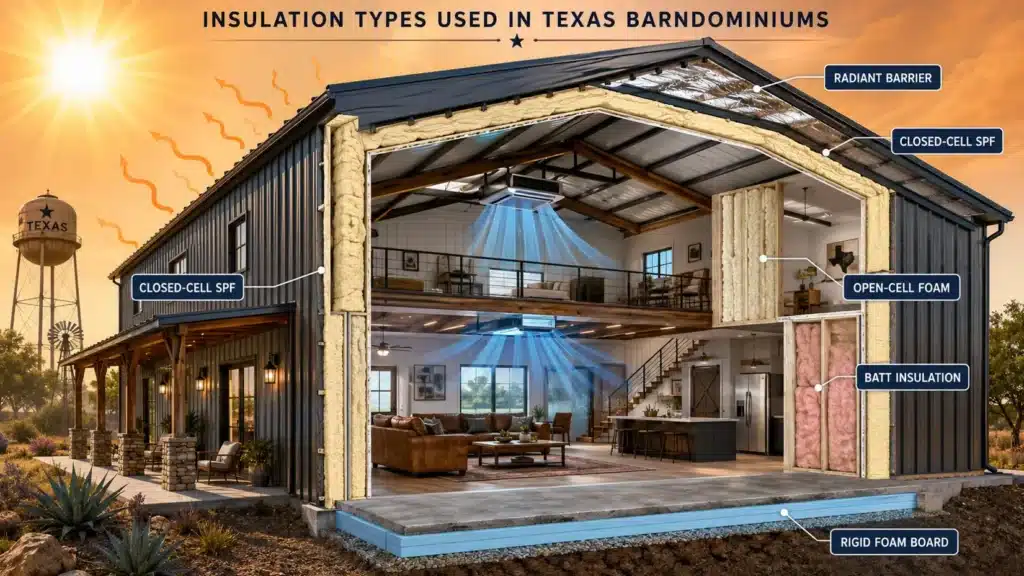
Closed-Cell Spray Polyurethane Foam (SPF)
Closed-cell spray foam is the most effective insulation option for metal barndominium construction in Texas. It delivers:
- High R-value per inch (approximately R-6 to R-7 per inch)
- An airtight seal that stops both air infiltration and moisture vapor
- A rigid layer that adds structural integrity to wall panels
- Condensation control, which is critical when Texas humidity meets cooled metal surfaces
Closed-cell foam is particularly effective when applied directly to the inside face of metal roof panels and wall sheathing. It eliminates the condensation problem at the metal surface and gives you a continuous thermal layer without thermal bridging through the framing.
The trade-off is cost. Closed-cell spray foam runs higher per square foot than batt or rigid board alternatives. On a 2,000 sq ft barndominium, that premium adds up. However, the long-term reduction in HVAC operating costs and the elimination of moisture-related problems (mold, rust, degraded insulation) typically justify the investment.
Open-Cell Spray Foam
Open-cell foam is softer, less dense, and costs less than closed-cell. It provides good air sealing and decent R-value (approximately R-3.5 to R-4 per inch), but it is vapor-permeable, meaning it does not function as a vapor barrier. In Texas’s humid climate zones, using open-cell foam on exterior metal surfaces without a separate vapor control layer can allow moisture to migrate into the building envelope.
Open-cell foam works well for interior partition walls and noise control applications. It is not the right primary choice for the roof deck or exterior walls of a metal barndominium in South or East Texas without careful vapor management.
Rigid Foam Board (XPS, EPS, Polyiso)
Rigid foam board insulation is used primarily as a continuous thermal break layer, installed outboard of the structural framing to interrupt the thermal bridging path through metal. Common applications include:
- Under-slab insulation to reduce heat gain through the concrete floor
- Between roof purlins and standing seam panels
- As a continuous exterior sheathing layer on walls
Polyisocyanurate (polyiso) delivers the highest R-value per inch of the rigid boards (approximately R-6 per inch at normal temperatures), though its performance drops in cold conditions. XPS and EPS are more stable across temperature ranges.
Rigid foam alone does not provide air sealing. All joints and edges need to be taped and sealed. Used in combination with spray foam or batt insulation, it can produce high-performing wall and roof assemblies.
Batt Insulation (Fiberglass and Mineral Wool)
Fiberglass and mineral wool batts are the most cost-effective insulation materials but require careful installation in metal-framed structures. Because batt insulation does not air-seal on its own, it must be paired with a proper air barrier and vapor control strategy.
The thermal bridging issue is also significant with batts alone. Metal framing members run directly through the insulation cavity, and the metal conducts heat regardless of how well the batt is fitted. For Texas builds where heat gain is the primary concern, batt insulation alone is rarely sufficient without a secondary thermal break layer.
Batts are commonly used in combination with spray foam or rigid board. For example, closed-cell foam applied to the exterior metal face to seal and break thermal bridges, with fiberglass batts filling the remaining stud bay depth.
Radiant Barriers
A radiant barrier is a reflective material, typically foil-faced, installed under the metal roofing to reflect solar radiation rather than absorb it. It does not provide R-value in the traditional sense, but it significantly reduces the radiant heat load entering the attic or roof cavity.
In Texas, where the sun is the primary driver of cooling load, a radiant barrier is a cost-effective addition to any roof assembly. It is not a substitute for insulation, but it reduces the temperature differential that insulation has to manage.
Learn more about maintanance for barndominium in Texas and what to expect in 10 – 20 years.
Key Areas to Insulate in a Texas Barndominium
Getting the right insulation material is only part of the equation. Where you apply it matters just as much.
Roof and Roof Deck
The roof is where the majority of heat gain enters. In Texas, the roof assembly typically needs to achieve R-30 at minimum for climate zones 2 and 3, and higher for zone 4. Closed-cell spray foam on the underside of the roof deck is the most reliable approach. It seals the metal, controls condensation, and delivers continuous R-value without thermal bridging through purlins.
Walls
Wall assemblies in metal barndominiums need to address thermal bridging through the girts and columns. The most effective wall systems combine a layer of closed-cell foam directly on the metal sheathing, then fill the remaining framing cavity with batts or additional foam. Target R-13 to R-21 for walls depending on climate zone.
Slab and Foundation
Concrete slabs conduct heat from the ground. In summer, a properly insulated slab stays cooler; in winter, it retains heat more effectively. Rigid foam board installed under the slab (or at the slab perimeter) is the standard approach. This is especially relevant in South Texas where the ground temperature stays warm year-round and slab heat gain adds to cooling loads. Builders planning barndominium foundations in Texas should consider insulation requirements at the slab design stage, as retrofitting after the pour is not possible.
Windows, Doors, and Penetrations
Even a perfectly insulated wall assembly loses performance if windows, door frames, and utility penetrations are not properly air-sealed and weatherstripped. In Texas, low-E (low emissivity) glass reduces solar heat gain through windows while still admitting natural light. Specify windows with a low Solar Heat Gain Coefficient (SHGC) for south and west-facing glazing.
Would you like to speak to qualified barndo builder in Texas?
HVAC Design for Texas Barndominiums
Insulation manages the thermal envelope. HVAC handles the remaining load. The two work together, and a barndominium with excellent insulation will require a smaller, less expensive HVAC system to maintain comfort.
Understanding the Unique HVAC Challenges in Barndominiums
Barndominiums present several challenges that standard residential HVAC design doesn’t fully account for:
- High ceilings and open volumes: Heat rises. Cooling a 12-foot or 14-foot ceiling space is different from a standard 8-foot ceiling. Poorly placed supply registers in a high-ceiling barndo will cool the upper portion of the room while occupants at floor level remain warm.
- Open floor plans: Large open areas without interior walls make zoning and temperature stratification more complex.
- Mixed-use spaces: Many Texas barndominium builds include attached shops, garages, or equipment bays that have entirely different conditioning requirements from the living areas.
HVAC System Options for Texas Barndominiums
Central Ducted Systems (Heat Pump or Split System AC with Furnace)
A central ducted system, either a heat pump or a split system air conditioner paired with a gas furnace, is the most familiar residential approach and works well for larger, fully finished barndominium interiors. The key is duct design. Ductwork in a high-ceiling, open-concept space needs careful layout to ensure even distribution and avoid temperature stratification.
In Texas, heat pumps perform well in climate zones 2 and 3 where winters are mild. A heat pump provides both heating and cooling in a single system, and in most Texas counties, it is the more energy-efficient choice compared to a gas furnace plus separate AC. For the Panhandle and extreme North Texas, where temperatures can drop significantly below freezing for extended periods, a dual-fuel system (heat pump with a gas furnace backup) provides reliable performance at the lowest operating cost across all conditions.
When sizing a central system, insist on a Manual J load calculation, a precise heat gain and heat loss calculation based on your specific floor plan, insulation levels, window placement, and local climate data. Oversized systems short-cycle (turn on and off too frequently), which reduces efficiency, increases wear, and fails to control humidity effectively in Texas.
Ductless Mini-Split Systems
Mini-split systems are increasingly popular for Texas barndominium builds, particularly for buildings with mixed-use layouts, phased finishing plans, or areas where running ductwork is cost-prohibitive.
A mini-split system consists of an outdoor compressor/condenser unit and one or more indoor air handlers (called “heads”) mounted on walls or ceilings. Each indoor head conditions a zone independently, which allows precise temperature control room by room and avoids heating or cooling unoccupied spaces.
Key advantages for barndominiums:
- No ductwork required, eliminating duct heat gain losses common in Texas attic-run duct systems
- Zoned control, so the shop can stay at a different temperature than the living area
- High efficiency ratings (SEER ratings of 18-25 are common for modern inverter-driven mini-splits)
- Quick installation and relatively straightforward commissioning
The limitation is that mini-splits work best when the indoor units are properly positioned for the ceiling height and room geometry. In a cathedral-ceiling great room, a wall-mounted head near the ceiling may deliver cold air at high level and leave the floor space warm. Ceiling cassette units or concealed duct mini-split heads are often better choices for open-volume spaces.
Zoning Systems with Ducted Equipment
For larger barndominiums, 2,500 square feet and above, a zoned ducted system gives you the distribution advantages of central ductwork combined with independent temperature control for different areas. Motorized zone dampers in the ductwork are controlled by separate thermostats for each zone, so the master bedroom suite, the great room, and the attached shop each maintain their own temperature settings without conditioning unoccupied areas.
Radiant Floor Heating
Radiant floor heating circulates warm water through PEX tubing embedded in or below the concrete slab, heating the floor surface which then radiates warmth upward into the space. It is the most even, comfortable form of heating available and pairs well with barndominium slab construction.
Radiant floor systems work well in North Texas and Panhandle builds where winter heating is a meaningful seasonal load. In South Texas, where heating demand is minimal, the economics are harder to justify. Radiant floor systems are typically paired with a separate cooling system (ductless mini-splits or ducted AC) since the floor cannot provide cooling.
SEER Ratings and Federal Efficiency Standards
SEER (Seasonal Energy Efficiency Ratio) measures air conditioner efficiency. As of 2023, the federal minimum for new residential AC equipment in the southern United States is 15 SEER2 (under the updated SEER2 testing methodology). Higher-end equipment reaches 18-22 SEER2.
For a Texas barndominium, targeting 16 SEER2 or higher is sound practice. The incremental cost difference between minimum-efficiency and high-efficiency equipment is typically recovered within a few years through lower monthly utility bills, particularly in climate zones where AC runs eight months or more annually.
Common Insulation and HVAC Mistakes in Texas Barndominium Builds
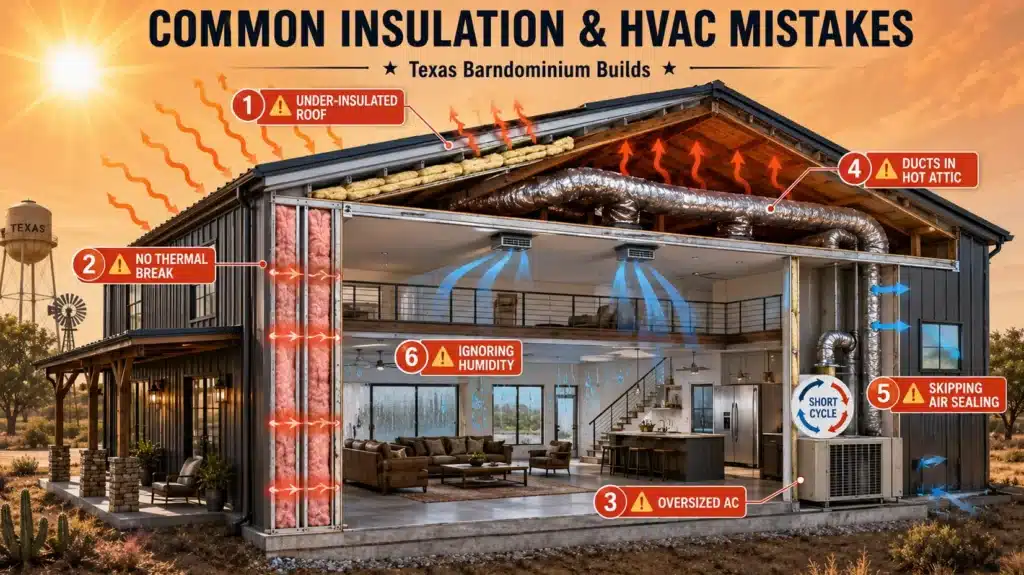
These errors show up repeatedly on Texas builds and they are expensive to correct after the fact.
- Under-insulating the roof: Walls get attention; the roof is where most heat enters. Undersized roof insulation is the most common reason a barndominium is uncomfortable despite appearing well-insulated.
- No thermal break at the framing: Installing batt insulation only, without addressing thermal bridging through metal framing members, can reduce the effective R-value of a wall assembly by 30-50%.
- Oversized AC equipment: Bigger is not better. An oversized AC unit cools quickly but runs in short cycles, never running long enough to dehumidify properly. In Texas’s humid regions, this results in a cold, clammy interior. Size to the actual load.
- Ductwork in unconditioned attic space: Ducts running through an uninsulated attic in Texas can lose 20-30% of their cooling capacity to heat gain before conditioned air reaches the living space. Ducts should be within the conditioned envelope where possible.
- Skipping air sealing: R-value does not stop air movement. Small gaps around penetrations, at framing connections, and at the building perimeter allow infiltration that defeats even high-R insulation systems.
- Ignoring humidity: Texas’s Gulf Coast and East Texas regions have serious humidity loads. An HVAC system that controls temperature but not moisture will produce a space that feels uncomfortable even at 72°F. Specify equipment with dedicated dehumidification capability or a standalone dehumidifier for high-humidity zones.
How Floor Plan Design Affects Energy Performance
Energy efficiency is not purely a materials and mechanical systems problem. The floor plan itself plays a role. Texas barndominium floor plans designed with energy efficiency in mind perform better without requiring more expensive materials or larger HVAC equipment.
Practical design decisions that affect energy performance:
- Orientation: Orienting the primary living areas toward the north and east reduces direct solar gain through windows. South and west-facing windows should be minimized or shaded by roof overhangs.
- Ceiling heights: High ceilings are aesthetically desirable in barndominium interiors, but they increase the volume of conditioned air. If you want cathedral ceilings, plan the HVAC system around them from the start.
- Attached spaces: Garages, shops, and equipment bays that share a wall with conditioned living space need to be thermally separated. A poorly insulated shared wall between a finished living area and an unfinished shop is a significant energy loss point.
- Roof overhangs: Adequate overhangs on south and west elevations shade wall and window surfaces from direct summer sun without blocking winter solar gain.
Have a specific question about your barndo plan?
Texas-Specific Considerations: Humidity, Wind, and Grid Reliability
Humidity Management
East Texas, South Texas, and the Gulf Coast are classified as humid subtropical climate. The HVAC system needs to manage latent load (moisture) as well as sensible load (temperature). Specifying equipment with a high latent capacity ratio, or adding a dedicated whole-home dehumidifier, is important for these regions. Uncontrolled indoor humidity leads to mold growth, which is a serious problem in metal structures where condensation on cool surfaces already creates moisture risk.
Wind Loads and Building Envelope Integrity
Texas wind loads, particularly in coastal counties, West Texas, and the Panhandle, affect both structural design and building envelope performance. A building envelope under wind pressure experiences significant infiltration pressure. This makes air sealing even more important in Texas than in calmer climates. The same storm-resistant design principles that govern how barndominiums are engineered for strong winds also reinforce the case for high-quality air sealing and continuous insulation systems.
Grid Reliability
After the 2021 winter storm and subsequent grid reliability discussions, some Texas barndominium owners are factoring energy resilience into their build plans. A well-insulated building envelope is the first line of defense in a grid outage. A barn with R-38 roof insulation and a tight building envelope will maintain livable temperatures significantly longer than a poorly insulated one. Solar panels with battery backup are increasingly common additions to rural Texas barndominiums, particularly in areas where grid tie-in is expensive or reliability is a concern. Rural Texas utility infrastructure and availability should be assessed early in the planning process, as it affects both mechanical system design and backup power feasibility.
Budgeting for Energy Efficiency in a Texas Barndominium
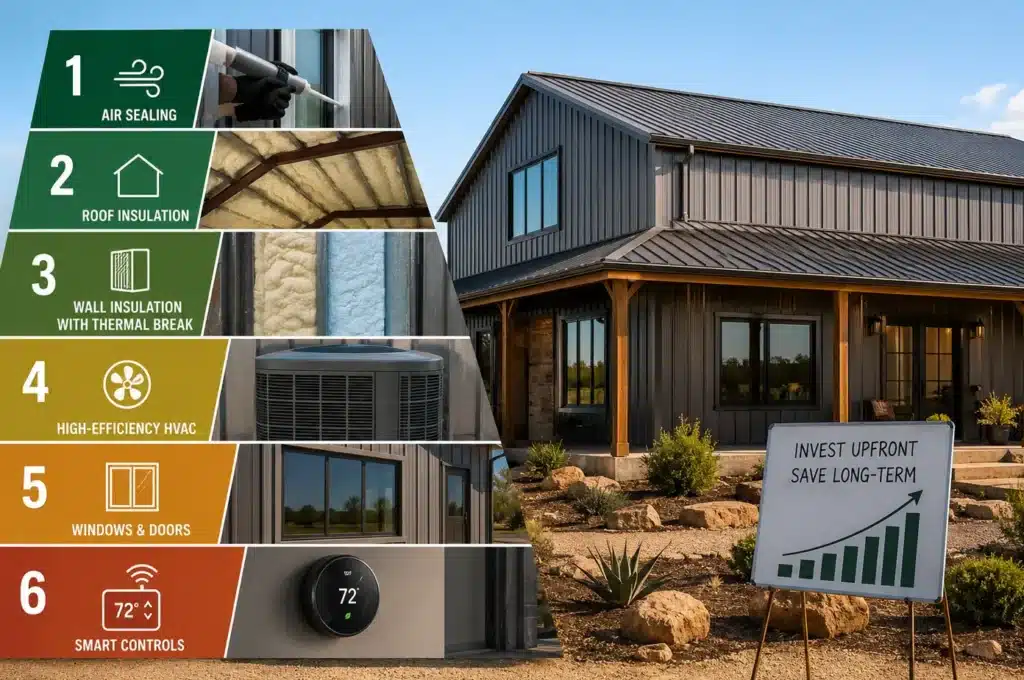
Energy efficiency investments in a barndominium follow a clear hierarchy. Spending in this order delivers the best return:
- Air sealing: Low material cost, high impact. Caulk, foam backer rod, tape, and weatherstripping at all penetrations and joints.
- Roof insulation: The highest-impact thermal upgrade in Texas. Prioritize roof R-value above all else.
- Wall insulation with thermal break: Closed-cell foam or continuous rigid board to address thermal bridging.
- High-efficiency HVAC: Properly sized, high SEER equipment. Don’t undercut the envelope with cheap mechanical systems.
- Windows and doors: Low-E glass, proper weatherstripping, and quality frames. Secondary priority after the envelope is addressed.
- Smart controls: Programmable and smart thermostats add value on top of a well-designed system, but they cannot compensate for a poor building envelope.
Understanding the full cost to build a barndominium in Texas requires accounting for energy efficiency investments upfront. Cutting insulation budget to reduce initial costs almost always results in higher lifetime operating costs, particularly in a climate like Texas where cooling systems run for the majority of the year.
Working with a Builder Who Understands Texas Energy Performance
Energy efficiency in a barndominium is not something that can be reliably added after the shell goes up. The insulation strategy, HVAC design, and air sealing details need to be built into the project from the design phase. That means your builder needs to understand building science, not just structural framing.
At Texas Complete Barndo Solutions, energy performance is part of the build specification, not an upgrade discussion at the end. With 25+ years of construction experience across Texas, we’ve built in every climate zone the state presents, from the Gulf Coast humidity of South Texas to the dry heat of West Texas and the cold winters of the Panhandle. If you’re in the planning stages and want to understand how insulation and mechanical systems should be spec’d for your specific site and floor plan, talk with a Texas barndominium expert on our team before you finalize your design.
Conclusion
Energy efficiency in a Texas barndominium comes down to three fundamentals: controlling radiant heat gain, eliminating thermal bridging, and correctly sizing your mechanical systems for the actual load. Texas’s climate is demanding, and a metal building envelope requires deliberate engineering to perform well.
Done right, a well-insulated barndominium with a properly designed HVAC system is comfortable, energy-efficient, and lower cost to operate than a comparable stick-built home. Done poorly, it will fight the Texas heat every summer and cost significantly more to condition than it should. The decisions that matter most happen at the design and specification stage, before a single panel goes up.
Frequently Asked Question
What is the best insulation for a barndominium in Texas?
Closed-cell spray polyurethane foam is generally the most effective single option for Texas barndominium construction. It provides high R-value per inch, functions as both a vapor barrier and air barrier, and controls condensation on metal surfaces, which is a critical issue in Texas’s humid regions. Many builders use closed-cell foam as the primary thermal and moisture control layer, with additional batt or rigid insulation to reach target R-values cost-effectively.
How much insulation does a Texas barndominium need?
Minimum requirements depend on your climate zone. For most of Texas (Climate Zones 2 and 3), code minimum for roof insulation is R-25 to R-30 above the deck. Walls typically require R-13 to R-21. However, code minimums are a floor, not a target. In Texas’s extreme heat, targeting R-38 or higher for the roof and R-21 or better for walls will reduce your HVAC operating costs materially. Your builder and HVAC contractor should conduct a Manual J load calculation based on your specific insulation levels and floor plan.
What HVAC system works best for a Texas barndominium?
There is no single answer. It depends on the size of the build, the floor plan configuration, and the climate zone. For fully finished barndominiums in the 1,500-3,000 sq ft range, a ducted heat pump system or central AC with a gas furnace backup is a common and effective choice. For mixed-use builds with shops or garages, or for phased construction, ductless mini-split systems provide flexible zoning without requiring ductwork. In all cases, proper Manual J load sizing is more important than the specific system type chosen.
Does a metal barndominium get hotter than a regular house?
Without proper insulation, yes, significantly. Metal conducts heat rapidly, and uninsulated or under-insulated metal roofing and walls will track outdoor temperatures closely. A properly insulated barndominium with a radiant barrier under the roof, closed-cell foam on the roof deck and walls, and a correctly sized HVAC system should be no less comfortable than a well-built stick-frame home, and can be more energy-efficient due to the tighter building envelope spray foam enables.
Can I add insulation to a barndominium after it’s built?
Some insulation can be added after construction, including blown-in insulation in accessible cavities, rigid board on interior wall surfaces, or blown-in insulation in attic areas. However, closed-cell spray foam applied directly to the exterior metal sheathing (the most effective approach for Texas) is best done during construction before interior framing and finishes are installed. Retrofitting spray foam to an existing structure is possible but significantly more disruptive and costly. If you are in the planning stage, the time to spec your insulation system is before the shell goes up.